

How To Repair Non Working Car Ham Radio

How can I fix my old radio?
Inappreciably a calendar week goes by without somebody sending me a message like this:
Help, Phil! I just bought a Schmidlap 357 and it looks dandy. But when I turn it on, it just makes a loud fizz (or doesn't make a audio, etc.) What should I practice??
If yous're in this position, here are some answers to assistance you lot get started.
Should I ready it myself, or hire someone to do it?
You don't need advanced electronics knowledge to ready nearly former radios. Tube-powered radios are simple in comparison to modern electronics. Most were built to conventional designs and they utilize replacement parts that are still readily bachelor. Fixing old radios can be an enjoyable hobby and yous tin can besides learn about a fundamental engineering of the modern era.
On the other hand, working on any electrical equipment can pose a danger of electric shock. And botched repairs can make a trouble worse, if you're careless. If you lot've never done such work, and you're not interested in learning how, it'due south all-time non to poke around blindly.
Dorsum in the day, when your radio was even so new, a repairman might fix information technology by popping in a new tube or 2, but those days are long gone. The passage of decades has turned many of your radio'due south former capacitors into garbage, so merely replacing tubes—even 100% of the tubes—won't magically bring it to life. It is standard exercise to replace all the radio's old electrolytic and paper capacitors, a labor-intensive chore.
The Beginner's section of this website has several articles to help yous get started repairing tube radios, if that is your choice. The Restoration section too has many articles explaining how I restored diverse radios; if yous skim a couple of those manufactures, you lot'll get a full general thought how much piece of work is needed to get an old radio working again. Then yous can make up one's mind whether to try the task yourself or farm it out.
How much volition it price to restore my radio?
Hiring a professional to restore your vintage radio might be expensive. A complete electronic restoration is a labor-intensive job, requiring the replacement of dozen or more age-damaged components (mainly capacitors), not to mention fixing other problems that your radio might have. I'd look to pay at least $100 for the electronics, and likely more for a complex multi-ring radio or i that has special problems.
If your radio's wooden cabinet needs refinishing, that's an additional toll. Professional refinishing is as well labor-intensive; I have paid anywhere from $400 to $800 to take a large wooden chiffonier completely redone.
If you spend hundreds of dollars restoring a vintage radio, don't expect to recover that money by reselling the restored fix. The market for restored tube radios is non strong, so don't spend a fortune on restoration unless y'all plan to keep your set forever.
Where can I observe someone to fix my radio?
It's preferable to find a repairman within driving altitude, to avert the cost and risk of shipping your radio long distances. Start past contacting a radio/Goggle box collector order in your area for a recommendation. Even if the nearest club isn't adjacent door, they might know someone closer to you lot. The Antiquarian Radio Classified website has a listing of clubs throughout the world.
If y'all do an Internet search for a phrase such every bit "vintage radio repair,", you can discover repair shops that advertise, although they may be located far from where you live.
Is there a volume that I can read?
Yes! Some splendid radio-repair books are listed on my page Antique Radio/Television Books. Your public library may take these, or they can exist ordered through a local bookstore or online. Many other out-of-print repair books can be found through used-book sources.
Are parts nevertheless available?
Yes. Normally needed electronic components are readily available. Encounter my Parts page.
What skills do I demand?
For the most mutual repairs, you need to exist able to read and to do simple soldering. Prophylactic Warning: Y'all also need to know how to work safely around electricity. Old radios behave loftier-voltage current that tin can crusade serious injury if y'all're careless. The repair books explain how to do this piece of work safely. Never stick your hands (or anything else) within an old radio if y'all don't know what you're doing. And keep ane hand in your pocket whenever you bear upon the probe of a test instrument to a chassis that'south powered up.
Do I need to get a schematic diagram before I kickoff?
Yes, especially if you're a beginner. Radios tin can exist stock-still using the general methods given in repair books, but many bug require specific answers, and the schematic may include other useful info, such as voltage and resistance charts for your radio.
Schematics for US and Canadian radios typically cost a few dollars and can be obtained from the sources in my Parts page. You can obtain many complimentary schematics by downloading from Nostalgia Air or visiting the reference desk at a decent-sized public library. Sams service manuals can as well be purchased directly from Sams.
Do I need to supercede all the tubes?
No! A common misconception near radio repair is that you lot should beginning by replacing tubes. Like a light seedling, a radio tube is vacuum-sealed; it doesn't deteriorate from simply sitting around. You lot don't need to replace a tube unless you accept some evidence that it has failed. Other components, such as capacitors, are more mutual causes of trouble than tubes.
What tools and equipment do I need?
The most essential tool is a soldering iron or soldering gun, available from many sources. You'll also need a coil of electrical solder, of course. I have used this gun and iron to restore many sets; both came from garage sales:

Yous may already ain the other small tools you'll need: a few screwdrivers (Phillips and normal head) in unlike sizes, a small adjustable wrench, pliers (regular and needle nose), wire cutter, a pocketknife for stripping insulation from wire, and the like.

In this photo, the red bulbous object is a "solder sucker," used for removing excess solder from old joints. The tool shaped like a dental pick is a stainless-steel hobby pick, handy for removing snipped pieces of wire from a solder terminal. The small metal alligator clips are used equally oestrus sinks; you can clamp them onto the lead well-nigh a fragile component, to prevent overheating while information technology's being soldered.
Speaking of clips, you'll also want to get (or brand) a few prune leads like these, to make temporary connections on your chassis for test equipment, so on:

Beyond hand tools, the well-nigh ofttimes-used piece of equipment in whatsoever restorer's workshop is a multimeter, a small device that measures voltage and resistance. Multimeters are available from many sources. For well-nigh $25, you can find one that gets the job done and lasts for years. Here is my everyday multimeter:

This modern Fluke meter has a digital numeric readout. In a few cases—notably, aligning radios and TVs—it'southward a footling easier to use an analog meter, which displays a value with a needle on a scale; when you're turning an adjuster back and along, seeking a summit point in a range, it'due south easier to watch a swinging needle than to decipher a changing stream of digits.
You can often observe used meters at a radio/Boob tube swap meet or flea market place. These meters may be quite inexpensive, only keep in mind that a vintage (say, fifty-year old) meter may itself require restoration, similar any other old device. The side by side photograph shows my Triplett 630-NA meter, a $twenty swap meet find:
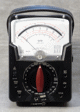
If I were merely starting out, I'd purchase a new multimeter: something more than modern than the Triplett and less pricey than the Fluke.
What equipment is nice, simply not necessary?
Beyond a multimeter, there are a few pieces of test equipment that are occasionally nice to have, only not vital for a coincidental restorer. These include signal generators and tube testers.
Bespeak Generator
For frequent repair work, the adjacent most useful item after a multimeter is a signal generator, a device that tin generate audio and RF (radio frequency) signals.
Point generators are useful for diagnosing troubles. By injecting a known signal into various stages of a radio or Telly's circuitry, you can zero in on the source of a problem. For case, if you inject an audio signal into the audio output stage and no sound comes out of the speaker, you know in that location's a problem in the audio output department.
A signal generator is too useful for realigning radios and TVs, although that specialized procedure isn't always necessary.
Here are ii of my bespeak generators: a uncomplicated "service grade" EICO 324 and a fancier (and much pricier!) "laboratory form" HP 8660C:


If I were starting out, I'd purchase a new bespeak generator with features like the EICO 324. A Rolls Royce-quality device like the HP 8660C is overkill for a casual restorer.
Tube Tester
Many people ask me whether they'll need a tube tester. My answer is no, for a beginner. Tubes are insufficiently reliable, and there are other ways to cheque them.
My commodity First Steps in Restoration explains how to perform a simple dud/non-dud test on a tube using an ohmmeter. You tin can also substitute a known-good tube in place of a doubtable tube, to run into if the radio or Goggle box plays better. Conversely, you tin put a suspect tube into a radio or TV that already works, to see if the performance changes.
If you restore more than a handful of sets per year, a tube tester may exist worth having. These photos show two of my tube testers, a vintage Precision 10-12 and a modern Sencore TC-162 "Mighty Mite":


The Mighty Mite is my everyday tester for small tubes. The Precision can check certain long-obsolete tubes that the Sencore tin can't handle, and so I might booty it out once or twice a year for those cases.
No tube tester is infallible, not even the plush ones. Simple emission-type testers like mine are generally good for alternative out very weak (or dead) tubes when you outset purchase a ready. Fancier mutual conductance-type testers tin check more tube characteristics, but they don't necessarily tell the whole story. Sometimes a tube that looks "weak" on a tester will perform just besides equally a brand-new tube in a particular circuit. And sure tube functions, such as oscillation, can't be judged by any tester.
Other Test Equipment
I own other, more specialized pieces of test gear, such as capacitor testers, an oscilloscope, and and then on. You tin can read about some of them in the Miscellany department of our Gallery. Each has its place, just none of them is used very often.
If you're a beginner, I'd suggest against loading upwards with a agglomeration of test equipment that y'all might rarely use or that you might find frustrating. Some devices, like an oscilloscope, are somewhat complicated and demand their own learning curve. It's amazing what a savvy restorer can accomplish using just a multimeter, and (mayhap occasionally) a bespeak meter. If yous're only going to buy ane or two pieces of test equipment, I'd lean toward buying new things rather than vintage gear, which may itself demand restoration before it's useful.
How tin I refinish the chiffonier?
Refinishing wooden radio/Idiot box cabinets is no different than refinishing any wooden furniture. My favorite volume on wood refinishing is The Weekend Refinisher by Bruce Johnson. For more details, run across Antique Radio/TV Books.
In this website's Restoration section, yous'll find articles describing how I refinished various types of cabinets.
My preference, which is shared by many collectors, is to restore wooden objects without making them look "newer than new" or erasing all evidence of age and use. If you strip or sand an antique cabinet downward to bare forest, you may destroy its collectible value, along with its graphic symbol. The same goes for applying non-accurate finishes, such as glossy polyurethane. The Weekend Refinisher explains how to notice what cease is on a slice and restore information technology authentically.
The vast majority of wooden radio cabinets were finished with lacquer. To restore your radio's original advent, yous should refinish it with lacquer. Avoid non-accurate finishes such as polyurethane, varnish, tung oil, etc. Those bogus finishes volition not look right, and polyurethane is well-nigh incommunicable to redo, if you lot brand a fault.
Restoring Bakelite or plastic cabinets is mostly a matter of cleaning and polishing. I recommend starting with the gentlest possible means and materials and resorting to stronger methods but if necessary. I begin with warm, soapy h2o, some clean, soft cloths, and a soft toothbrush for the small crannies. Cotton Q-tips and round toothpicks as well come in handy for tight spots. Beware of powerful solvents, especially when working with an unknown mod plastic. Nothing is more disheartening than watching your newfound treasure starting time to deliquesce under your fingertips! For everyday cleaning, I use nothing stronger than Windex or isopropyl alcohol (rubbing alcohol).
For cabinet polishing, I prefer Novus Plastic Polish, grades #1 and #2, bachelor from Antiquarian Electronic Supply. Novus shine is gentle enough to safely smooth the most delicate plastic dial covers, still the #2 grade works on Bakelite, too. Other collectors shine with various substances, such as very fine-course automotive rubbing compound, power buffing wheels, and and so on. Some collectors wax Bakelite cabinets afterwards polishing, but I've not institute that worth the bother, if you've done a good job of polishing. Be patient and stay with soft cloths and elbow grease.
Circumspection: the shiny surface layer of Bakelite is quite thin; if you lot smooth likewise difficult with harsh abrasives, yous'll dig down into the pulpy underlayer of the Bakelite, which goose egg will make shiny once again. If your cabinet is damaged from sanding or too-harsh polishing, the just remedy is to repaint it.
Cracks in Bakelite and plastic cabinets exist re-glued with cyanoacrylate ("crazy glue") if the break is clean. Larger defects in a plastic chiffonier tin be patched with a production called "Plas-T-Pair," available from Antique Electronic Supply. Larger breaks in a Bakelite chiffonier may be harder to repair, although I have heard of people patching them with a mixture of ground Bakelite and some sort of glue.
What'southward the all-time style to learn?
The best learning method is to watch over the shoulder of an experienced repairman. If you bring together a local radio/Tv collector's society, y'all might observe someone willing to give you some pointers.
Our Restoration section has many articles on restoring specific radios. These articles comprise all sorts of tips and practical advice near repairing electronics and refinishing cabinets. Books, as mentioned earlier, are another excellent resources.
Be sure to check out the Antiquarian Radio Forums website discussions. Browsing these forums will uncover a wealth of information about restoration techniques, and you can also inquire forum members for advice about your project.
Over again, if you lot're a complete novice in electronics, I recommend practicing on a junky radio before you tear into your treasured antique. A visit to the local thrift shop may provide a suitable tube-powered patient for only a few dollars. It won't exist exactly like your "real" radio, merely the techniques that y'all learn will be generally applicable. Practicing on a junker will tell yous whether you similar this activeness, and you tin brand those inevitable beginner'southward mistakes on a set that doesn't take not bad emotional or monetary value.
Take fun!

How To Repair Non Working Car Ham Radio,
Source: https://antiqueradio.org/howfix.htm
Posted by: mossmangratting43.blogspot.com
0 Response to "How To Repair Non Working Car Ham Radio"
Post a Comment