

How To Repair Non Skid On Pj
By Tom Pawlak — GBI Technical Advisor
If the patterned non-sideslip on your production-built fiberglass boat needs repair, you lot may be interested to know that flexible molds are available for making professional-looking repairs.
If the damage to the deck is more than than cosmetic, repair it prior to continuing. Refer to the procedures for structural repair as described in our Fiberglass Boat Repair & Maintenance manual.
Flexible molds are designed to lock into the existing molded pattern on your boat and work best if the design has not been painted over. If pigment has been applied or if debris has accumulated in the pattern, the fit volition be poor at all-time and the repair will be harder to blend in. Mold release is applied to the flexible mold at the manufacturing plant so epoxy or the polyester gelcoat used to brand the repair will non stick to it.
-
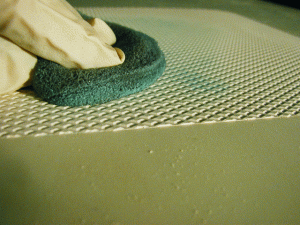 Apply mold release wax to existing non-skid prior to beginning the actual repair. Spread wax well beyond the bodily repair because gelcoat will drift. Employ wipe on/wipe off method to employ wax.
 - Employ a router to remove the damaged non-slip. Remove only the thickness of the blueprint, no more than. If y'all grind through
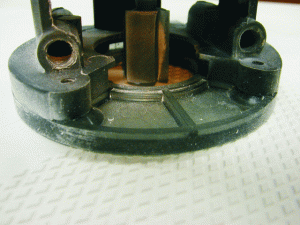 the opaque white gelcoat or you can see the night substrate through information technology, y'all must then make full the dark low spots with gelcoat so that afterwards molding a new not-skid you practise non meet the nighttime laminate through the thinnest, lowest parts of the gelcoat pattern.
 If the harm went beyond the base of operations gelcoat thickness, or you are finishing a structural repair, you volition have to router a void to fill up with a thick enough layer of gelcoat to make an opaque base for the design. This layer of gelcoat is so machined with a shallower pass on the router, to level the opaque layer and establish the base of the non-slip design. Interruption the corner of the routed area with sandpaper.
-
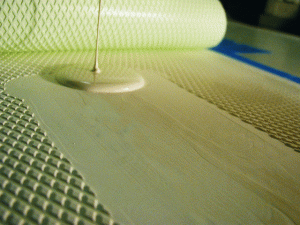 Position the flexible mold over the area to be repaired, moving it around until information technology locks onto the pattern. Tape one end down securely and roll back the flexible mold until the repair area is accessible.
 - Pour catalyzed gelcoat (you can use epoxy only it will crave painting) near the flexible mold.
-
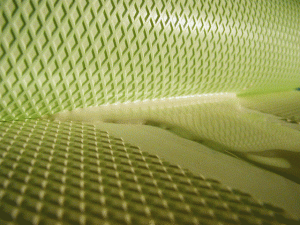 Slowly flex the mold forrard while continuously engaging the non-skid pattern. Use a stiff rubber or plastic spreader to uniformly apply pressure to the backside of the flexible mold, effectively squeezing out the backlog gelcoat. Permit the gelcoat to cure before removing the mold. Clean upwards backlog gelcoat motion picture (surrounding the repair) with an air nozzle or by brushing the area with a stiff bristled brush. When done correctly, the repair will non be detectable.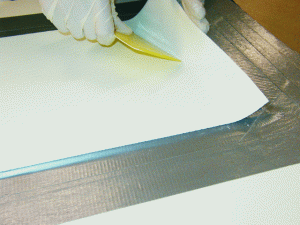


How To Repair Non Skid On Pj,
Source: https://www.epoxyworks.com/index.php/repair-non-skid-and-get-professional-results/
Posted by: mossmangratting43.blogspot.com
0 Response to "How To Repair Non Skid On Pj"
Post a Comment